Showing posts with label amazing. Show all posts

Thursday, April 18, 2013

Sigur Ros LIVE!

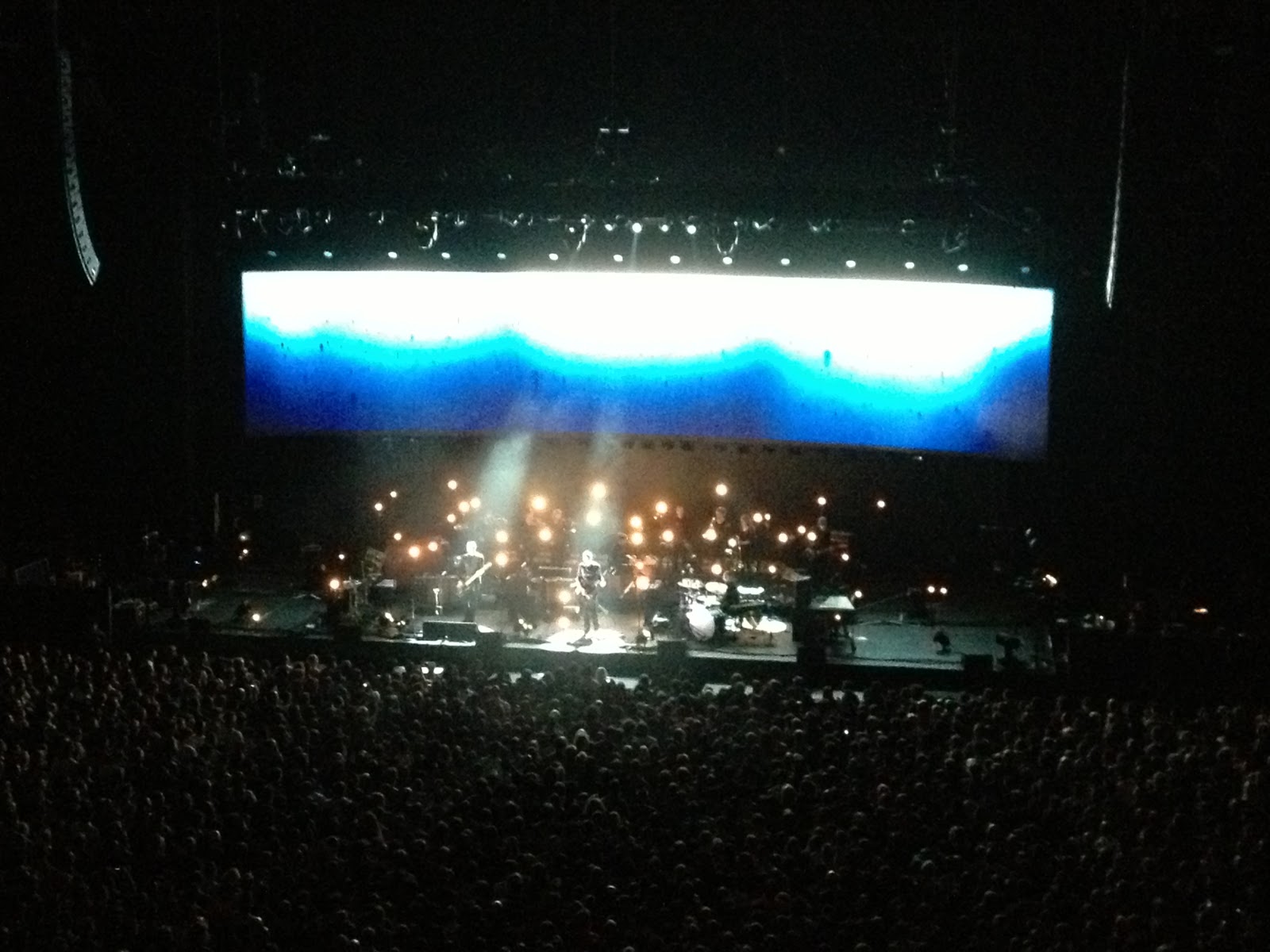
Last night, April 17, 2013, I finally got to see my beloved Sigur Ros in person! When they have rolled through Northern California in the past, the timing has never been right for me to see them, but the stars aligned this time, and their appearance at the Bill Graham Civic Auditorium in San Francisco was, for me, a highly emotional spectacle. Seen from absolutely perfect seats, I must add...I couldn't have asked for a better vantage point.


They opened the show behind a scrim, on which was projected what looked like dark moving clouds...and a backlit Jónsi was seen intently bent over his guitar sawing away with his cello bow. But the scrim dropped during the next number to reveal a massive, panoramic projector screen which was alternately raised above the band and lowered to stage level, depending on the mood and lighting effects for each song. The film and graphics projected on the screen for each song included shots and clips from that song's accompanying video, if one was created. So, for "Sæglópur," for instance, we were presented with images of the young boy swimming underwater from the official video, seen here. In each instance though, the video was not shown in its entirety, but used as a way to evoke, and was mixed with sparks, clouds, rippling water, swirling galaxies, shooting stars, smoke, glittering dust motes, or other textural elements. Some songs that did not have an accompanying video were surprisingly even more beautiful: once, on a jagged, rocky landscape, tiny figures of people appeared, holding flashing beacons, but halfway through the song, the beacons rose up, floating over us in a moment of gentle emotional release, suggesting the possible release of the soul.


Strategically placed small golden lights on rods were scattered across the stage which, when illuminated, resembled twinkling fireflies or a sea of pulsing, glowing orbs. Special lights--sometimes emitting blinding flashes--aimed out at the audience added to the crescendos, and silhouetted the band along with the string and horn sections.


I must confess to a goose bump moment when I heard Jónsi start to sing the first song of the evening... I had to remind myself that I was actually hearing, in person, that voice that has the quality of a universal angel of compassion. His voice and phrasing are a brilliant counterpart to the often expansive, grand, shaking and shattering sound Sigur Ros can produce... a cosmic, transcendent sound that invokes at once creation and destruction. It was a marvel to experience these crescendos first hand, to hear them go on for five minutes or more, and just when one thinks the song is going to end, the crescendo gets ratcheted up so the crescendo gets a crescendo. Simply awe-inspiring.

They played all my favorite songs, like "Glósóli" and track one from their "( )" release. They even performed "Brennisteinn" as well as "Kveikur" (in English: "Quaker") from their forthcoming release of the same name. But most importantly, I got to hear the heart-stopping "Svefn-g-englar" or "Sleepwalkers" in English. This song was the first Sigur Ros composition I ever heard, more than a decade ago and it occupies a very special place in my heart. And for the gentle, lulling "Tjú" refrain (in Icelandic, the word "Tjú" is a comforting sound one makes to a baby), I was fascinated to watch Jónsi perform a little sonic trick: he raised his guitar and sang into it so the electric feed picked it up and brought it to the speakers sounding muffled and far away. Watch him do this in the video below (enlarge to full screen)... and notice the pulsing, glowing lights...


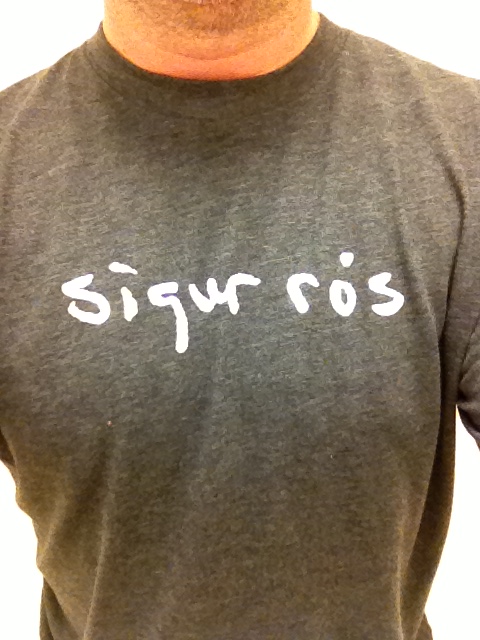
I bought a great tour tee of very soft grey jersey on which is printed, in highly reflective silver metallic, the name/logo of the band.


It was a lovely evening. Thanks to my friends Judy and Bianca for coming along, and thanks to my man for the tickets, an early birthday present!


http://www.sigur-ros.co.uk/

Friday, March 29, 2013

Bio-Computers!

This reminds me of the David Cronenberg film "eXistenZ"...

This incredible piece of scientific news yesterday comes from Stanford School of Medicine. The possibilities are mind-boggling.

Biological transistor enables computing within living cells, study says
BY ANDREW MYERS

When Charles Babbage prototyped the first computing machine in the 19th century, he imagined using mechanical gears and latches to control information. ENIAC, the first modern computer developed in the 1940s, used vacuum tubes and electricity. Today, computers use transistors made from highly engineered semiconducting materials to carry out their logical operations.

And now a team of Stanford University bioengineers has taken computing beyond mechanics and electronics into the living realm of biology. In a paper published March 28 in Science, the team details a biological transistor made from genetic material — DNA and RNA — in place of gears or electrons. The team calls its biological transistor the “transcriptor."

“Transcriptors are the key component behind amplifying genetic logic — akin to the transistor and electronics,” said Jerome Bonnet, PhD, a postdoctoral scholar in bioengineering and the paper’s lead author.

The creation of the transcriptor allows engineers to compute inside living cells to record, for instance, when cells have been exposed to certain external stimuli or environmental factors, or even to turn on and off cell reproduction as needed.

“Biological computers can be used to study and reprogram living systems, monitor environments and improve cellular therapeutics,” said Drew Endy, PhD, assistant professor of bioengineering and the paper’s senior author.

In electronics, a transistor controls the flow of electrons along a circuit. Similarly, in biologics, a transcriptor controls the flow of a specific protein, RNA polymerase, as it travels along a strand of DNA.

“We have repurposed a group of natural proteins, called integrases, to realize digital control over the flow of RNA polymerase along DNA, which in turn allowed us to engineer amplifying genetic logic,” said Endy.

Using transcriptors, the team has created what are known in electrical engineering as logic gates that can derive true-false answers to virtually any biochemical question that might be posed within a cell.

They refer to their transcriptor-based logic gates as “Boolean Integrase Logic,” or “BIL gates” for short.

Transcriptor-based gates alone do not constitute a computer, but they are the third and final component of a biological computer that could operate within individual living cells.

Despite their outward differences, all modern computers, from ENIAC to Apple, share three basic functions: storing, transmitting and performing logical operations on information.

Last year, Endy and his team made news in delivering the other two core components of a fully functional genetic computer. The first was a type of rewritable digital data storage within DNA. They also developed a mechanism for transmitting genetic information from cell to cell, a sort of biological Internet.

It all adds up to creating a computer inside a living cell.

Digital logic is often referred to as “Boolean logic,” after George Boole, the mathematician who proposed the system in 1854. Today, Boolean logic typically takes the form of 1s and 0s within a computer. Answer true, gate open; answer false, gate closed. Open. Closed. On. Off. 1. 0. It’s that basic. But it turns out that with just these simple tools and ways of thinking you can accomplish quite a lot.

“AND” and “OR” are just two of the most basic Boolean logic gates. An “AND” gate, for instance, is “true” when both of its inputs are true — when “a” and “b” are true. An “OR” gate, on the other hand, is true when either or both of its inputs are true.

In a biological setting, the possibilities for logic are as limitless as in electronics, Bonnet explained. “You could test whether a given cell had been exposed to any number of external stimuli — the presence of glucose and caffeine, for instance. BIL gates would allow you to make that determination and to store that information so you could easily identify those which had been exposed and which had not,” he said.

By the same token, you could tell the cell to start or stop reproducing if certain factors were present. And, by coupling BIL gates with the team’s biological Internet, it is possible to communicate genetic information from cell to cell to orchestrate the behavior of a group of cells.

“The potential applications are limited only by the imagination of the researcher,” said co-author Monica Ortiz, a PhD candidate in bioengineering who demonstrated autonomous cell-to-cell communication of DNA encoding various BIL gates.

To create transcriptors and logic gates, the team used carefully calibrated combinations of enzymes — the integrases mentioned earlier — that control the flow of RNA polymerase along strands of DNA. If this were electronics, DNA is the wire and RNA polymerase is the electron.

“The choice of enzymes is important,” Bonnet said. “We have been careful to select enzymes that function in bacteria, fungi, plants and animals, so that bio-computers can be engineered within a variety of organisms.”

On the technical side, the transcriptor achieves a key similarity between the biological transistor and its semiconducting cousin: signal amplification.

With transcriptors, a very small change in the expression of an integrase can create a very large change in the expression of any two other genes.

To understand the importance of amplification, consider that the transistor was first conceived as a way to replace expensive, inefficient and unreliable vacuum tubes in the amplification of telephone signals for transcontinental phone calls. Electrical signals traveling along wires get weaker the farther they travel, but if you put an amplifier every so often along the way, you can relay the signal across a great distance. The same would hold in biological systems as signals get transmitted among a group of cells.

“It is a concept similar to transistor radios,” said Pakpoom Subsoontorn, a PhD candidate in bioengineering and co-author of the study who developed theoretical models to predict the behavior of BIL gates. “Relatively weak radio waves traveling through the air can get amplified into sound.”

To bring the age of the biological computer to a much speedier reality, Endy and his team have contributed all of BIL gates to the public domain so that others can immediately harness and improve upon the tools.

“Most of biotechnology has not yet been imagined, let alone made true. By freely sharing important basic tools everyone can work better together,” Bonnet said.

The research was funded by the National Science Foundation and the Townshend Lamarre Foundation.

Information about Stanford’s Department of Bioengineering, which also supported the work, is available at http://bioengineering.stanford.edu. The department is jointly operated by the School of Engineering and the School of Medicine.

Original story at Stanford Medicine website:
http://med.stanford.edu/ism/2013/march/bil-gates.html

Monday, March 18, 2013

Just watched...

...Terrence Malick's 2011 masterpiece "The Tree Of Life."


I had been meaning to see Malick’s “The Tree Of Life” ever since it came out in 2011 and won the Palme d’Or at Cannes. I love Malick’s films, and I have “The Thin Red Line” listed on my All-Time Favorite Films List to the right on this page. But after hearing a lot of general grousing about this film, I was a little anxious. I had hoped it was not “incomprehensible” as many critics claimed. Even the word “pretentious” was leveled at it. But that actually gave me a clue as to what to expect. I have noticed, after my many years of being here on this planet, that when people sneer slightly and use the word “pretentious” to describe a piece of art—film, painting, sculpture, dance, etc.—they might as well be saying “I’m too stupid to understand what that was about. I suspect as much and that threatens me because I don’t want to appear stupid. So I am going to attack it and set myself higher.” I am not saying that a piece of art can’t fail, can’t lack for anything, or can’t fall short of its aim. If that is the case, it is better to be specific… as specific as possible. Calling something “pretentious” just does not cut it. What about it made you think it was pretentious? Was the story convoluted? In what way? Did you feel pieces of the narrative were left out or not alluded to? Were there leaps in logic that did not make sense? Did you feel the theme was unfulfilled because of costume choices, lighting choices, music choices? Was the acting flat or unbelievable? Was the melody based on something else or uninspired altogether? Did it fail to engender emotion in you? WHY? Just saying that something is “pretentious” is not enough. If you make a sweeping dismissive comment without anything to back it up, then you look like the fool you are trying not to be. And if you automatically label anything that is trying to say something profound as “pretentious,” that is proof that you can’t grasp larger concepts. To make a large-concept piece of art, the artist, whether novelist or director or composer, must reach, must take the risk and work on a grand scale. Profundity is not automatic grounds for criticism or penalty but there are many who are threatened by such vision. I don't think I have ever earnestly used the word "pretentious" in my life. It is a meaningless, hollow word for me.

Terrence Malick was a philosophy major under Stanley Cavell at Harvard University and graduated summa cum laude and Phi Beta Kappa so it is only natural that he would involve very large concepts in his original screenplays and films. As I mentioned above, “The Thin Red Line” is one of my favorite films and considering his background, it is clear to see in that film existential ideas translated into poetry… cleverly disguised as a war film (at the end of the day, it is anything but). When an artist makes a large-concept statement, I like to pay attention. It is rare to begin with that someone dares to make a large-concept statement and it shouldn’t be dismissed with an easy wave of the hand as “pretentious.” And “The Tree Of Life” is one of the largest artistic statements I have ever seen on film. The scope, the intent, the vastness of what Malick conveys in it is breathtaking, heart-stopping, mind boggling. I don’t want to give away too much detail. As I have said here on “Oh, By The Way” in past film reviews, I don’t want to take away the special experience of seeing a film for the first time, seeing a film the way the director intended, for everything to come at you fresh. I will say that on the surface, and really, it is only the surface, the film is a study of a rather dysfunctional family in Texas in the 1950s and 60s. Brad Pitt and Jessica Chastain are stunning as Mr. and Mrs. O’Brien. Having said that, I assure you the point of this film is not the family themselves, and I have not given anything away in this magical film. No, not magical...magical is diminutive. That word makes it sounds like something for children. It is… it is holy. And I absolutely do not mean that in an “organized religion” way. It is holy in the sense of "transcendent." Malick has dared to tell a story that transcends itself. It references a reality and truth that renders the story into its own context, and by extension, does so for all of our lives. We all exist in our own context but belong to something much, much, much larger; something we cannot hold in our minds for long without losing hold of where we are, who we are, what we do, what we wish for and live for. But there it is. That is the truth. The film encompasses and is a survey of this duel nature of the universe itself ("grace" and "nature"), of creation and destruction and the very human, mistaken way of seeing those two things as separate entities. Remember: transcendence. Despite the fact that characters in the film are religious and talk to “God,” the film is decidedly anti-religion with the juxtaposition of individual lives and situations against the beginning and end of our solar system. How ridiculous to talk to a pretend man in the sky and ask questions about "why" things do or don't happen when all around us screams and reels the workings of the cosmos itself through the birth of stars in stellar nurseries, the evolution of life, and the eventual entropy and collapse of all. There is an enormous difference between "religion" and "spirit"... they are separated by light years.


The impressionistic, non-linear narrative of "The Tree Of Life" reminds me somewhat of Tarkovsky’s “The Mirror” in that it is an assortment, a mélange, a kaleidoscope of experiences, memories, thoughts, fantasies. And not just of one person, as in the case of "The Mirror," but of a group of people. Just like “The Mirror,” telling a story this way is very dream-like and creates a direct path to the pre-conscious. And in this way, “The Tree Of Life” is one of the few films in the history of cinema that are actually purely cinematic, just like dreams. Film is a visual medium and Malick uses it to his full advantage, giving us a vast expanse of information and ideas visually, without much dialogue. When people speak in the film, or more commonly when we hear their whispered thoughts and inner monologue, it is as if someone has called your name while you are asleep. Dreams can only convey a narrative or an idea to us in one way: it shows us pictures. A dream can’t—and indeed does not need to—tell us what it wants us to know, it shows us. That is the language of signifiers. That is the primordial, pre-conscious language of our psyches, our souls. That is our first, original language before words. Watch. Look. See. Understand. We are given everything Malick wants us to grasp, but not in a way that matters on this physical plane. While the visuals are gorgeous and pristinely filmed—the film is a miraculous, true study of present moments (the way Tarkovsky studied rain hitting a tree leaf, for example)— and the special effects are some of the best I have ever seen, one must interpret and feel “The Tree Of Life” for it to work.

Recommend? If any of this review resonates with you, if any of what I have said strikes a chord with you, then please, by all means, partake of this transcendent artistic experience. Invest in it.
Watch. Look. See. Understand.

http://www.twowaysthroughlife.com/
http://www.foxsearchlight.com/thetreeoflife/

Friday, November 30, 2012

Portrait of DNA

Impressive science news: for the first time, DNA has been truly photographed. Italian scientist Enzo Di Fabrizio, physics professor at the Magna Graecia University in Catanzaro AND Head of the Nanostructures Department of the Italian Institute of Technology in Genoa (sheesh, what an overachiever...), and his team used a high-powered electron microscope to catch actual images of strands of DNA, the building blocks that support all life, suspended like a tightrope between two very small silicon structures. Truly breathtaking.


His published findings can be read on-line here!