These gorgeous, ethereal color field studies are by Greek photographer Peter Zéglis. I live in northern California by the ocean, so these monochromatic scenes of sky and sea are very familiar to me. I'd love to print one of these photos in a 6' x 6' format (or even larger) and put it in the living room of one of my interior design clients. Meditative, restful, even spiritual... set against a very dark wall, navy blue perhaps. Beautiful.
http://peterzeglis.com/
Showing posts with label landscape. Show all posts
Tuesday, April 2, 2013
Saturday, December 29, 2012
BEAUTY: Art--Alex Roulette
I have to tell you that these paintings by Alex Roulette scare the sh*t out of me. It has to do with seeing these pristine landscapes, classic iconic sights of the continent before European settlers arrived, before the slaughter of Native Americans and animals; seeing these landscapes with the first little signs of a civilization that will destroy it all--clues of the dystopia on the way, freeways, water parks, roadside signage. As if one has found the first tiny telltale sign of a disease--a sore, a bruise, a spot of blood in a cough--that will eventually take one's life. And paradoxically, it also has to do with the kind of isolationism (presented as "independence") that one finds in many parts of the United States, an isolationism that spawns xenophobia, and a certain small-town mentality that is hostile to education, the arts, and a worldly perspective. I know, I know, I am projecting all this onto these enigmatic scenes. But isn't that what good art does? It provokes one's imagination, one's own associations, one's own thoughts and memories. What do you get out of the narrative of these slightly surreal images?
http://www.alexroulette.com/index.html
BEAUTY: Art--Sven Kroner
Much like Alex Roulette, Sven Kroner paints idyllic landscapes tainted by civilization but in Kroner's vision, we are looking back at the few little remnants of industrialized culture from the post-apocalyptic future. Highways are abandoned and now only used by wildlife, a lone office chair sits incongruously in a decimated snowy landscape or on a beach, and broken cars and washing machines sit in a swamp while the survivors of humanity live in tents on the shore. Another kind of dystopia...after the fall...
http://www.svenkroner.de/index.html
Labels:
art,
beauty: art,
future,
landscape,
painter,
painting,
Sven Kroner
Saturday, November 3, 2012
BEAUTY: Photography--Andrew Brodhead
Andrew Brodhead's most recent series of photographic work features bodies wrapped in plastic and eerily floating in static landscapes.
Artist's Statement:
"Growing up in Savannah, Georgia, I worked at my parent’s health food store, and as a kid my daily job was to take out the recycling. Through the years I started to realize how much was not recyclable. I began to think about landfills and where everything goes. There are islands of plastic taking over the oceans, the earth is suffocating from plastic that never biodegrades, and our water and environment are leaching toxic estrogenic compounds. Visually, I want to convey the sacrifice we have made by our consumption and waste. The wrapped bodies represent invasive cocoons floating over vulnerable landscapes."
It also speaks to the related idea of mortality, and how the elements that compose our bodies return to the natural world.
http://andrewbrodhead.com/
Artist's Statement:
"Growing up in Savannah, Georgia, I worked at my parent’s health food store, and as a kid my daily job was to take out the recycling. Through the years I started to realize how much was not recyclable. I began to think about landfills and where everything goes. There are islands of plastic taking over the oceans, the earth is suffocating from plastic that never biodegrades, and our water and environment are leaching toxic estrogenic compounds. Visually, I want to convey the sacrifice we have made by our consumption and waste. The wrapped bodies represent invasive cocoons floating over vulnerable landscapes."
It also speaks to the related idea of mortality, and how the elements that compose our bodies return to the natural world.
http://andrewbrodhead.com/
Wednesday, October 3, 2012
BEAUTY: Photography--Sara Ferguson
Sara Ferguson has made some lovely portraits of California landscapes and scenery. I am sure that when people who do not know the state very well think of California, these are not the images that spring to mind. However, these scenes and landscapes are very familiar to me, and this is part of the diverse, back-roads California that I love.
Top to bottom: Northern California; Bodega Bay, California; Hwy 58, California; Point Reyes, California; near Kernville, California; San Diego, California; reflection near Port Costa, California
http://saraferguson.carbonmade.com/
Top to bottom: Northern California; Bodega Bay, California; Hwy 58, California; Point Reyes, California; near Kernville, California; San Diego, California; reflection near Port Costa, California
http://saraferguson.carbonmade.com/
BEAUTY: Photography--Daniel Kukla
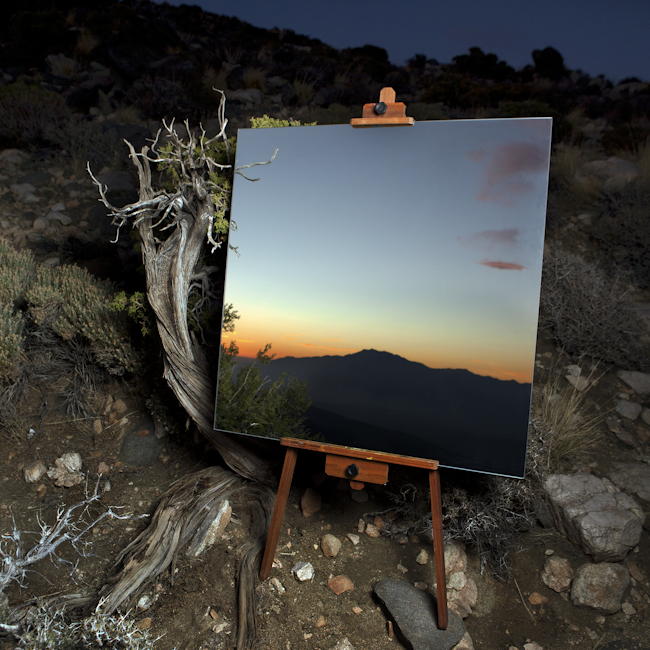
Photographer Daniel Kukla has created an intriguing series called "The Edge Effect."
From his website:
"In March of 2012, I was awarded an artist's residency by the United States National Park Service in southern California’s Joshua Tree National Park. While staying in the Park, I spent much of my time visiting the borderlands of the park and the areas where the low Sonoran desert meets the high Mojave desert. While hiking and driving, I caught glimpses of the border space created by the meeting of distinct ecosystems in juxtaposition, referred to as the Edge Effect in the ecological sciences. To document this unique confluence of terrains, I hiked out a large mirror and painter’s easel into the wilderness and captured opposing elements within the environment. Using a single visual plane, this series of images unifies the play of temporal phenomena, contrasts of color and texture, and natural interactions of the environment itself."
http://danielkukla.com/
From his website:
"In March of 2012, I was awarded an artist's residency by the United States National Park Service in southern California’s Joshua Tree National Park. While staying in the Park, I spent much of my time visiting the borderlands of the park and the areas where the low Sonoran desert meets the high Mojave desert. While hiking and driving, I caught glimpses of the border space created by the meeting of distinct ecosystems in juxtaposition, referred to as the Edge Effect in the ecological sciences. To document this unique confluence of terrains, I hiked out a large mirror and painter’s easel into the wilderness and captured opposing elements within the environment. Using a single visual plane, this series of images unifies the play of temporal phenomena, contrasts of color and texture, and natural interactions of the environment itself."
http://danielkukla.com/
Subscribe to:
Posts (Atom)